


Oopsie Croco
Croco Studio Interactive
My first impression of Oopsie Croco was that it wants to make strategy feel quick rather than intimidating. This is a free adventure game from Croco Studio Interactive, built around roguelike auto-battler play and the fun of finding combinations that work better than expected. You are not being asked to control every movement or react to every second of a fight. The interesting decisions happen before and between battles: choosing what to build, deciding which upgrade is worth the risk, and learning why one combination survives while another falls apart.
That makes it a good fit for someone who enjoys experimenting but does not always have time for a long, traditional adventure game. I could imagine opening it during a short break, making a few meaningful choices, and stopping before the session becomes a major commitment. At the same time, its roguelike structure means that progress is not simply a straight climb. A promising attempt can change direction quickly, and part of the appeal is understanding what each run teaches you.
Getting comfortable with the game’s basic rhythm
When you begin, the most useful expectation is to treat each run as a learning exercise instead of demanding a perfect result immediately. The auto-battler format puts the emphasis on preparation. Your job is to assemble a setup that can handle the challenges ahead, then watch the result and use what happened to improve the next decision. That is a different kind of adventure from one based on direct movement, aiming, or button combinations.
I found this structure reassuring for a first-time player because the game’s main question is usually clear: what can I change before the next encounter? If a battle goes badly, the answer is not necessarily that you played too slowly. It may be that your choices did not support one another, that you invested in a tempting option too early, or that you ignored a weakness in the overall setup. This turns failure into useful information, provided you pay attention to the relationship between your choices and the outcome.
The roguelike element also changes how I judge success. A run does not need to reach its absolute limit to be worthwhile. A first attempt can succeed simply by showing you which choices are reliable, which ones are too narrow, and when a flexible option is better than a powerful-looking one. That mindset prevents the early game from feeling like a test you are expected to pass without understanding the rules.
Related News






The game is rated Everyone 10+, which places it in a space that should feel approachable to younger players and adults alike while still leaving room for strategic decision-making. I would still recommend that new players take a few minutes to understand the flow rather than rushing through every choice. The presentation may look friendly, but the combination system can reward careful thinking more than casual tapping.
What to do during the first few minutes
My advice is to resist the urge to select an option just because it looks strongest in isolation. In a combination-focused auto-battler, a modest choice that supports the rest of your setup can be more valuable than a dramatic choice that has no partner. Look at what you already have, identify the direction it suggests, and then choose additions that make that direction more consistent.
For a first run, I would also avoid trying to understand every possible interaction at once. Pick a simple plan and observe it. Notice which part of the setup seems to carry the battle, which part regularly underperforms, and whether your result changes when you prioritize balance over a single impressive effect. This gives you a practical foundation without turning the opening into a spreadsheet exercise.
Gallery
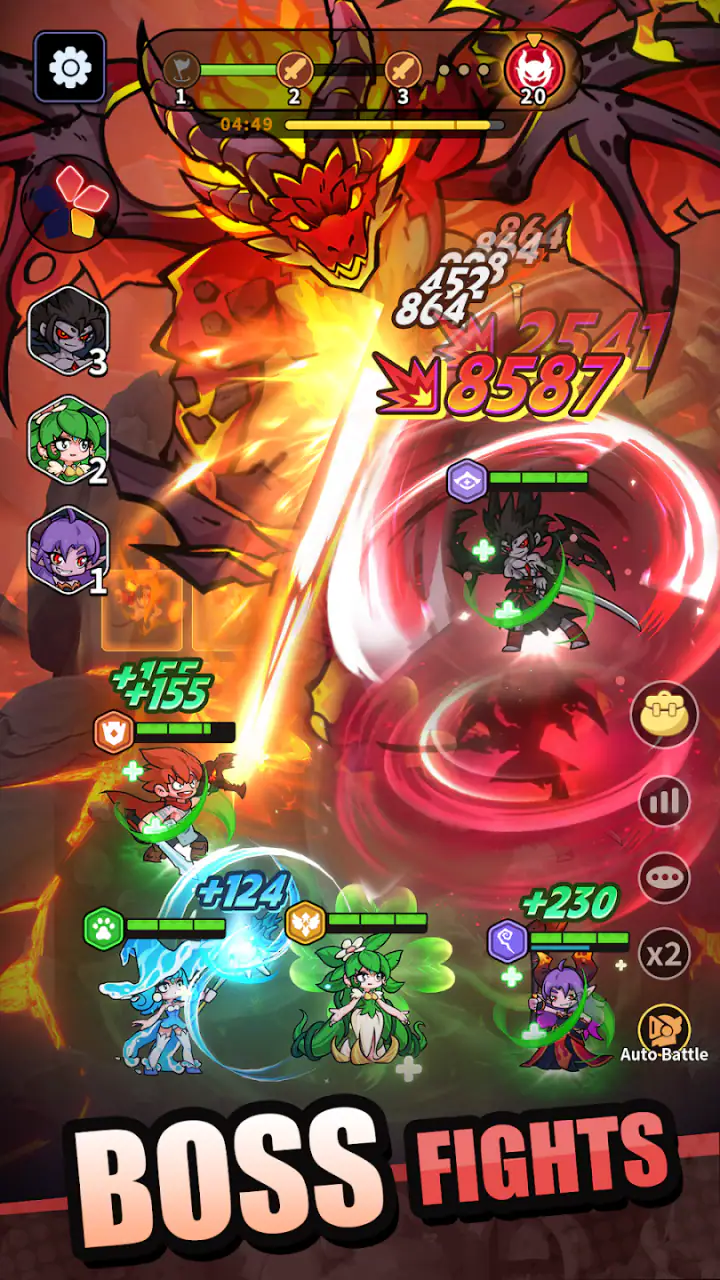
There is another small but important habit: pause mentally after each result. Instead of immediately starting the next encounter, ask what actually caused the outcome. Was the setup missing durability, damage, or a useful connection between its parts? Even without writing anything down, this short review makes later choices more deliberate. It is one of the easiest ways to get more from the game without needing advanced knowledge.
From installation to a meaningful first success
The cleanest path to a first satisfying result is to define success narrowly. Do not begin by trying to discover the best possible build. Begin by trying to create a setup whose choices make sense together and can survive the next challenge. Once that works, you have something more valuable than a lucky win: you have a repeatable idea to test.
For example, if an early selection appears to point toward a particular style, keep later decisions close to that direction unless the game gives you a strong reason to change. This does not mean ignoring every alternative. It means avoiding a scattered collection of attractive options that never become a coherent plan. The trade-off is important: specialization can make a setup stronger, while flexibility can rescue a run when the choices do not cooperate.
When the first successful battle arrives, take note of why it felt successful. Perhaps the setup finally had enough support around its main strength, or perhaps you stopped spending choices on unrelated improvements. That observation becomes your first personal rule for future runs. The game becomes much more enjoyable once you are testing your own rules rather than simply hoping the next selection solves everything.
I would not worry if the first attempt ends earlier than expected. Roguelike games often make their systems clearer through repetition, and this one is particularly dependent on recognizing combinations. The useful question after a setback is not “How do I win every time?” but “Which decision would I make differently if I saw the same situation again?” That question keeps the learning process concrete.
Where new players may become confused
The biggest source of confusion is likely to be the difference between an attractive individual choice and a useful overall combination. A choice can appear powerful while contributing little to the setup you are building. Conversely, an option that looks ordinary may become important because it completes a relationship between other parts. I recommend judging selections by their role in the whole run, not by their immediate appearance.
Another common mistake is changing direction too often. Experimentation is central to the game, but constant switching can make it impossible to tell what worked. On your first few attempts, try to keep one idea intact long enough to evaluate it. Once you understand its strengths and weaknesses, then test a different approach. This turns experimentation into comparison rather than guesswork.
It is also easy to assume that a poor result means the game is entirely random. The roguelike format certainly introduces changing circumstances, but your response still matters. You can improve the odds of a good outcome by recognizing when a choice fits your current setup, when it fills a gap, and when it is better to preserve flexibility. The more carefully you make those distinctions, the less arbitrary the game feels.
Finally, do not measure your progress only by how far a run goes. A run that reveals a useful interaction can be more valuable than one that advances slightly farther through luck. I especially like this approach for players who become frustrated by repeated attempts. Each session should answer at least one question about the game’s combinations. If it does, it has moved you forward.
How it compares with more traditional adventure games
Players coming from conventional adventure games should know that this is not primarily about exploring a map, solving environmental puzzles, or directly controlling a character through every encounter. Its adventure identity comes through the changing run structure and the decisions that shape your route to success. If you want a story-led journey with constant movement and direct action, another adventure game may suit you better.
Compared with a standard strategy game, the auto-battler design reduces the need for constant input during combat. That can be a strength when you want to focus on planning, but it can also feel less satisfying if your favorite part of strategy is issuing commands in the middle of a fight. Here, the pleasure comes from seeing whether your preparation was sound and from adjusting the plan afterward.
It also differs from a simple casual game because the combination system gives your choices consequences beyond the immediate moment. You can play casually, but the most rewarding sessions involve remembering what happened and applying that lesson. In my view, this places Oopsie Croco between a quick pick-up-and-play title and a deeper strategy game: accessible at the start, but more interesting when you begin examining your decisions.
That middle ground is its strongest audience. I would recommend it to someone who likes trying different builds, watching a plan develop, and learning from failed attempts. I would be more cautious about recommending it to a player who dislikes restarting, wants complete control during battles, or prefers a fixed progression with no surprises. The roguelike structure is not a minor detail; it defines the way the game asks you to think.
Practical advice for building better runs
My first concrete tip is to choose a central idea before chasing individual upgrades. It can be as simple as deciding that your next few choices should support the strongest part of your current setup. This reduces decision fatigue and makes the effect of each addition easier to evaluate. If the plan stops working, you will also know which assumption failed.
Second, use variety carefully. A setup with no flexibility can collapse when the available choices do not match its needs, but a setup with too many unrelated parts may never develop enough strength. I prefer adding one stabilizing choice before pursuing another ambitious combination. That extra bit of balance can be more useful than reaching for a high-ceiling option immediately.
Third, treat the end of a run as a review screen in your own head. Identify the first moment when the setup began to struggle, not only the final defeat. That moment often reveals the real problem. Perhaps the build had been relying too heavily on one interaction, or perhaps an earlier choice created a weakness that became visible later. Correcting the first warning sign is usually more effective than reacting to the final result.
A fourth tip is to separate testing from winning. On one run, deliberately explore a combination you do not fully trust. On another, use the safest choices you understand. Comparing those experiences helps you learn the cost of experimentation. This is especially useful for new players because it prevents every unusual decision from feeling like a mistake.
For a realistic everyday scenario, imagine having a short evening break after work or school. You can begin a run with one clear goal, such as testing whether two compatible choices can support each other, then stop after the next meaningful result. You do not need to turn the session into a long gaming appointment. The game works best in that situation when you focus on one question instead of trying to master the entire system in one sitting.
Free access, device expectations, and spending choices
The game is free to download, so it is easy to try without committing money at the start. It includes optional in-app purchases ranging from $0.99 to $99.99 per item. That range deserves attention before you spend: a small purchase and a high-priced item represent very different commitments, and I would advise deciding on a personal limit before browsing any optional offers.
Because the core appeal is experimentation, I would first play enough to decide whether the run-based loop suits you. If you enjoy improving through repeated attempts, the free entry point gives you a fair chance to make that judgment. If the restart cycle already feels tiring, spending more is unlikely to solve the underlying mismatch. The right reason to buy anything would be to support a game you already enjoy, not to force yourself to like its structure.
The current version is 1.8.6 and the game requires Android 6.0 or later. That makes checking the operating system on an older phone worthwhile before installing. The title has reached over 100 thousand installs and holds a 4.6 average from around 5.7 thousand ratings, which suggests that many players find the concept appealing. I would still use those figures as context rather than a guarantee, because the important question is whether you personally enjoy auto-battler decision-making.
The release is dated June 9, 2026, and Croco Studio Interactive is the developer behind it. For someone choosing between several free adventure games, these details help identify the specific version and creator, but they do not replace trying the opening loop yourself. The first few runs will tell you more about the fit than a rating alone.
Who should try it, and who should skip it
I think Oopsie Croco is a strong choice for players who enjoy discovering combinations gradually. It suits people who like asking why a run succeeded, comparing one setup with another, and making a better decision after a failure. It can also work well for players who want strategy without having to control every battle directly.
I would skip it if your ideal adventure game requires continuous exploration, a large story campaign, or precise real-time control. I would also hesitate to recommend it to anyone who finds repeated attempts discouraging. The game’s learning curve is not necessarily about complicated controls; it is about accepting that a failed run can be part of the intended experience.
For younger players within the Everyone 10+ rating, I would encourage an adult to explain the optional purchase range before play, especially if the device allows purchases. That is less about the game’s strategy and more about making the free-to-try model comfortable for the household. The best experience comes from treating purchases as optional rather than as a requirement for understanding the game.
After spending time with it, my recommendation is straightforward: try it if the idea of assembling a plan and watching it prove itself sounds more appealing than direct action. Start slowly, keep your first strategy simple, and review the moment a run begins to weaken. The first meaningful success is not merely reaching a battle win; it is understanding why your choices worked together. That is where this small adventure game becomes more than a sequence of automatic fights and starts to feel like a strategy playground worth returning to.
My final view is positive but specific. Oopsie Croco is not a replacement for every adventure game, and its roguelike reset cycle will not suit everyone. For the right player, though, the combination of quick sessions, changing runs, and build-focused decisions creates a satisfying reason to come back. I would install it for experimentation rather than for a guaranteed smooth climb, and I would give it a few thoughtful attempts before deciding whether its particular rhythm belongs in my regular game rotation.
FAQs for Oopsie Croco
What is Oopsie Croco and how is the game played?
Oopsie Croco is a casual mobile game centered on a playful crocodile character and simple, accessible gameplay. Players generally guide the character through short challenges, avoid hazards, collect useful items, and try to achieve the best possible score. Its straightforward controls make it suitable for quick sessions, although later stages may require more accurate timing and faster reactions.
Is Oopsie Croco free to download and play?
Oopsie Croco can typically be downloaded for free, allowing users to try the main gameplay without paying upfront. However, the app may include optional in-app purchases, advertising, or extra content depending on the version and platform. Before downloading, it is worth checking the store listing for current pricing, available purchases, and whether advertisements can be removed.
Does Oopsie Croco require an internet connection?
The basic gameplay experience may work without a constant internet connection, which makes Oopsie Croco convenient for short sessions while travelling or when mobile data is unavailable. Some features, such as advertisements, updates, cloud services, leaderboards, or promotional content, may require connectivity. Availability can vary between versions, so offline functionality should be confirmed on your device.
Is Oopsie Croco suitable for children?
Oopsie Croco uses a colorful, cartoon-style presentation and uncomplicated mechanics that can appeal to younger players. Nevertheless, parents should review the age rating, advertising practices, privacy information, and any in-app purchase options before allowing children to play. If the game displays ads or offers purchases, parental controls are recommended to prevent accidental taps or unexpected charges.
What devices are compatible with Oopsie Croco?
Compatibility depends on the operating system, device model, and the version of Oopsie Croco currently available in the Google Play Store or Apple App Store. Most supported phones and tablets should handle a lightweight casual game, but older devices may experience slower performance or installation limitations. Check the official store page for required Android or iOS versions before downloading.
Pros
- Simple controls make it easy for younger players to pick up.
- Short rounds are convenient for quick play sessions.
- Bright visuals give the game a cheerful
- child-friendly appearance.
- The crocodile theme feels playful and distinctive.
- Progressive challenges can help maintain interest over time.
Cons
- Gameplay may feel repetitive after several sessions.
- Limited depth could disappoint experienced mobile gamers.
- Some levels may rely heavily on timing and trial-and-error.
- Performance can vary on older or less powerful devices.
- The colorful presentation may not appeal to every player.


